Update 10/06/2026:
- added connection to templates
- added dark/light mode
Update 09/06/2026:
- added different sources (Github of Catalan CKM, Arketyper, Apperta, Highmed and international CKM), which ups the analyzed templates to 471 and a total 932 archetypes.
- every archetype has now a descriptive text that explains the direct inclusions.
- an Excel file with the raw data can be downloaded
After my impromptu presentation at the Converge&Collaborate meeting in Dublin, I mentioned that one of my goals for the Archetype Companion was to explore template modelling patterns - something @heather.leslie had reminded me about various times during the project.
IMHO this wasn’t fully achieved during the project, partly because the right approach to analysing archetypes for patterns wasn’t obvious to me at the time. In the conversation we had, one possible solution came up: look at how archetypes are actually used within templates.
Based on this idea, I created a small demo. I took all OET (template) files from the international CKM GitHub repository and analysed which archetypes include which other archetypes.
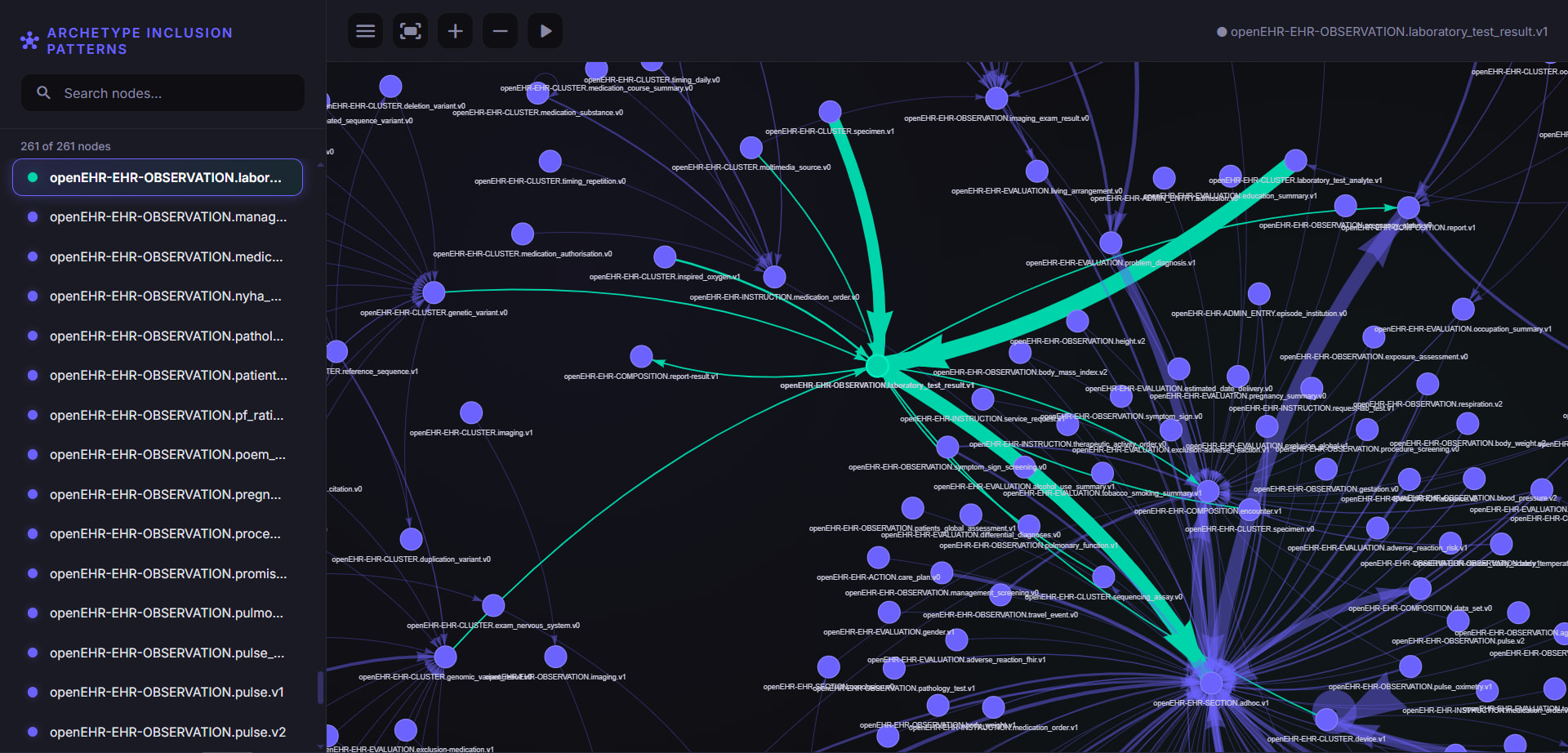
The result is a network graph that you can access and explore here: https://martinkochdesign.github.io/openEHR_archetype_inclusion_patterns/
The network graph shows the relationships with arrows:
- A → B: means that in a template, archetype A was included in archetype B. The wider the arrow line, the more frequently the inclusion occurs between all templates.
In the following example image we can see:
openEHR-EHR-OBSERVATION.laboratory_test_result.v1 includes often
- openEHR-EHR-CLUSTER.laboratory_test_analyte.v1 and
- openEHR-EHR-CLUSTER.specimen.v1
and only sometimes
- openEHR-EHR-CLUSTER.multimedia_source.v0
- openEHR-EHR-CLUSTER.inspired_oxygen.v1 and
- others
It itself is included often in
- openEHR-EHR-SECTION.adhoc.v1
and sometimes in
- openEHR-EHR-COMPOSITION.report-result.v1
- openEHR-EHR-COMPOSITION.encounter.v1 and
- openEHR-EHR-COMPOSITION.report.v1
This graph could be extended to cover a list of GitHub repositories and be automated in the future.
I’d love to hear your thoughts:
-
Do you think this is useful?
-
Are there other approaches or types of information that you would consider valuable?
-
Are you working on something similar and want to explore this further?
-
Do you have a public GitHub repository with OET templates that you would like to see incorporated?