Some really good points and perspectives here! 
I agree with @heather.leslie that it is a good thing if a “local” score is made available in the international ckm. It can be used anywhere, so it is really only it’s origin that is local, it’s usage should ideally not be constrained by locking it in a local repository. It is also very helpful to see what others have done. The review process for such an archetpye could be a bit interesting though.
@varntzen, you are of course right that the generalization can be made in absurdum. I dont think a generic score is a good thing. I do think that there are good arguments for (and likely also against) having a common PEWS. Another one is how a system implementer or consumer of an openEHR based platform should know what to query for if you can have an arbitrary number of PEWS archetypes. PEWS seems like a somewhat international concept, why should you not be able to query for it? Lets say that the business process in hospital 1 is to use PEWS X and in hospital 2 they use PEWS Y, having distinct archetypes makes such a use case difficult for implementers as the consumer needs knowledge about all potential PEWS archetypes to not risk missing important clinical data.
Maybe with binding of the archetypes to SNOMED CT you could use subsumption testing for that use case. Like in this example, the consensus here seems to model the archetype on the “lowest” level of specificity. If let’s say there is a Norwegian PEWS concept that is a child to the generic PEWS concept, that could solve part of the problem.
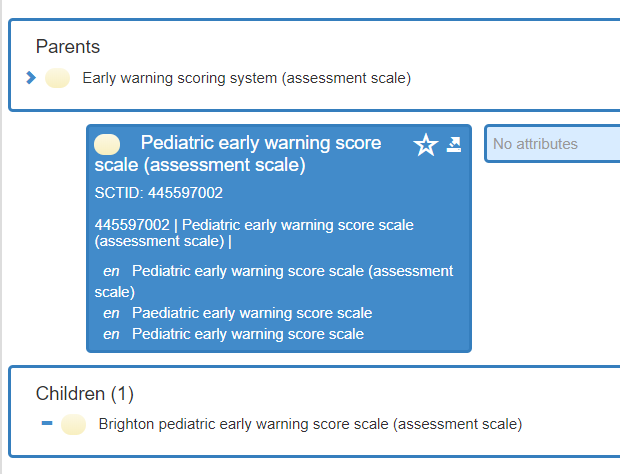
My main argument (or mainly raising the topic for discussion) is really that modelling the clinical knowledge outside the information model makes modelling concepts with more advanced or local rules easier while at the same time not removing any clinical precision. Not that all PEWS are alike or even that they should be modelled in the same archetype.