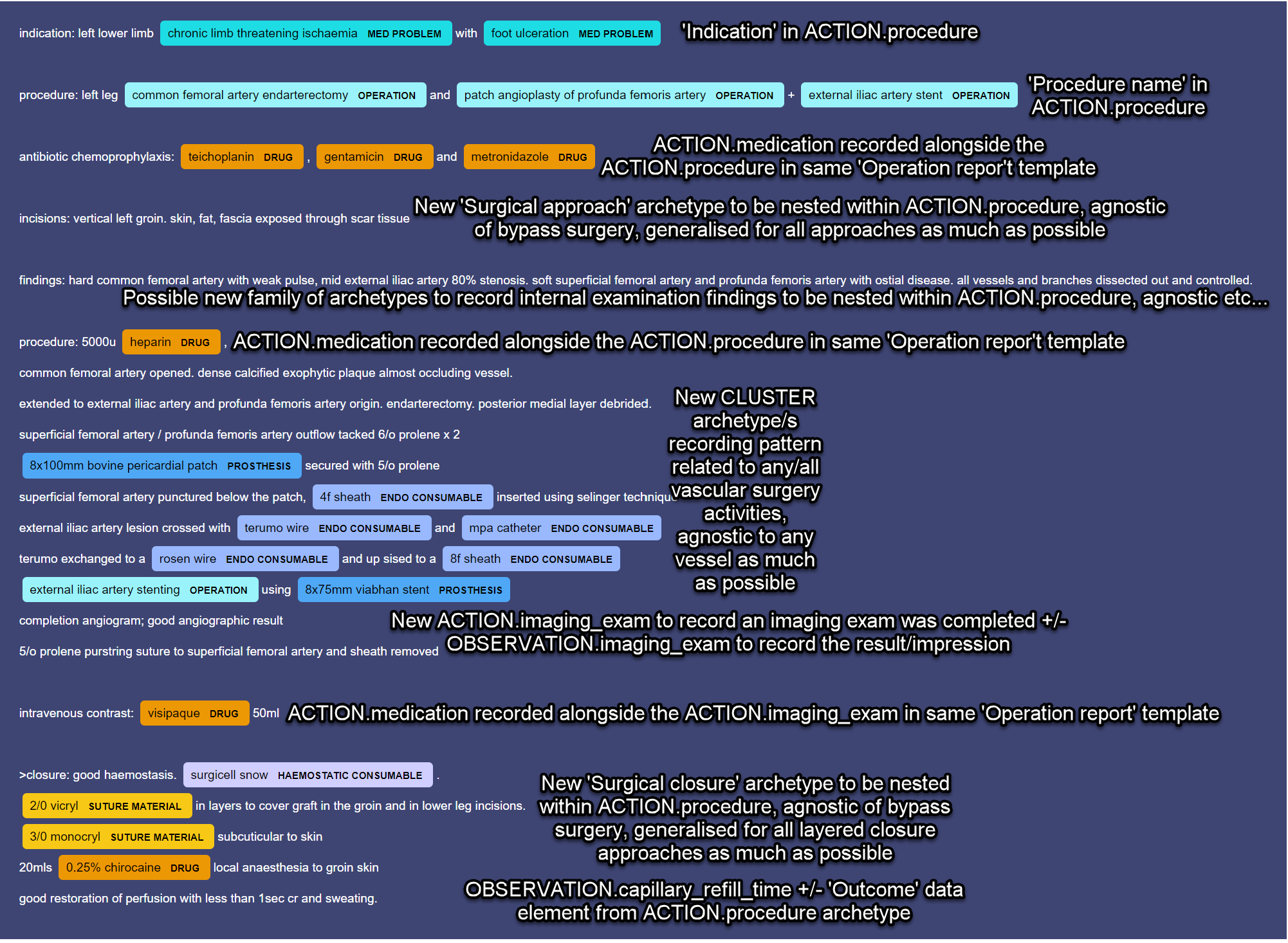
My approach to the Operation report would be to create a template using COMPOSITION.report at the root level, then adding a variety of ENTRY-level archetypes, extended as necessary with CLUSTER archetypes.
In the attached example:
-
Existing archetypes
- COMPOSITION.report
- ACTION.procedure
- ACTION.medication
- OBSERVATION.imaging_exam_result
- OBSERVATION.capillary_refill
-
Proposed new archetypes
- Surgery-specific CLUSTER archetypes related to general surgical concepts such as approach, closing etc for nesting within the ‘Procedure detail’ SLOT in ACTION.procedure
- Vascular surgery-specific activity-related archetype/s for nesting within the ‘Procedure detail’ SLOT in ACTION.procedure
- ACTION.imaging - to record the process of planning to completion of an imaging examination/procedure
-
Terminology value sets - used to populate the myriad of procedure and imaging test names, device names, consumables etc. This is where you’d find “bypass”, “endarterectomy” and “covered stent" and all the rest of the procedure names - a value set used in the ‘Procedure name’ data element, within the ACTION.procedure archetype.
In this way, we should be able to build up a common-ish, reusable pattern of archetypes as building blocks that form the foundation for representing the most common types of vascular surgery. Then we can aggregate and constrain the archetypes to suit a typical vascular surgical process, such as your use case.
Adding relevant terminology value sets will support further refinement and differentiating between the same type of surgery performed in different locations or under different circumstances.
Additional archetypes may need to be added for outlying situations such as when complications occur or more complex procedures are undertaken eg combos, pregnancy, paediatrics etc.