Hi everyone,
I have recently joined the clinical data modeling team in Basel and am taking my first steps with the archetype designer. As Olha has outlined above, we are at the beginning of a cardiology project with the long-term aim to model the cardiology documentation (i.e., clinical examination, imaging, interventions etc.).
Currently, I am working on the clinical examination of the heart and cardiovascular system. The idea is to model it with the complete physical examination of all organ systems in mind. So far, I have found the following resources:
• Proposal for the physical examination pattern from Heather:
• CKM project on physical examination findings:
Based on these resources, I have tried to model the examination of the heart, starting from CLUSTER.exam-heart.v0:
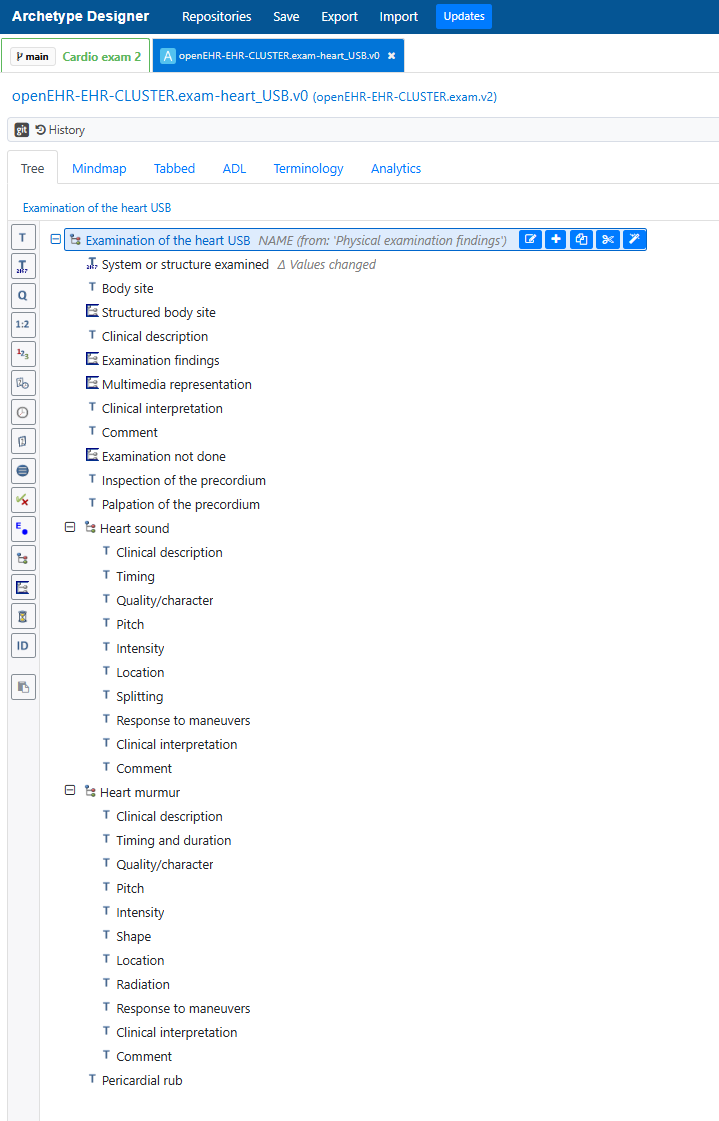
The data elements are based on the textbook “Macleod’s Clinical Examination” and the physical examination standard on internal medicine wards at the University Hospital of Basel. It is a first draft and not at all meant to be final. I’m a clinician who has mostly worked in internal medicine and have little experience in data modeling, so the archetype probably looks very crude to experienced modelers. I find it quite difficult to get my head around how to model the complexity of the physical examination. I’m looking for other people in the openEHR community working on this who could provide some guidance, especially regarding the general structure.
At the moment, I’m mostly thinking about the following questions:
- Is building specific CLUSTER archetypes for each exam finding, specialized from the generic exam archetype still the recommended way to model specific examination content?
- Are there other approaches?
- What would be the recommended way to model findings such as cyanosis or oedema (a v0 CLUSTER for oedema exists already)?
Would be great to find other people working on the physical exam of the heart and beyond 
Kind regards,
Simon