I’m new to openEHR and try to map an legacy project’s clinical document to openEHR templates. Finding the corresponding archetype is not so easy, for example, I can’t find where “mouth opening” is. In my requirements, “mouth opening” supports two types of unit, like “40 mm” or “3 fingers wide”.
One of my guess is that use “Examination of the Mouth” archetype, however, it lacks a place to fill in the numerical value.
Hi, and welcome to the wonderful openEHR community!
Thyro-mental distance (TMD) is a length outside of the mouth itself, it’s the distance from the tip of the chin to Adam’s apple. So it is a kind of body segment length, as @heather.leslie is mentioning in the link you referred to above. Although she rejected her own idea back in March 2019, the Observation Archetype: Body segment length [openEHR Clinical Knowledge Manager], published June 2020, opens for the distance between any two points of surface anatomy. In the Use section, it says:
“Rather than create an archetype for every single possible body segment measurement, the intent of this archetype is to use a common recording pattern to capture any, or all, other possible measurements between two identified body points, identified by the ‘Body segment name’ data element.”
While TMD is not added as option in the coded text alternatives, it can be added to the archetype. This is a non-breaking change and can be done quickly. As an alternative, the Text option can be used, if you are in a hurry.
If the TMD is solely used as part of a assessment in anesthesiology to predict potential difficulties of tracheal intubation, TMD might be part of a standardised assessment, and reside in an archetype made specifically for that purpose. Is this the case?
And I guess the mouth opening can be another body segment length. Maybe. Or not! Is it standarised, from edge of the front upper teeth to the lower front teeth?
The Examination of the mouth archetype is meant for the mouth as a whole, with specific CLUSTER archetypes added in the ‘Examination findings’ SLOT. “Mouth size” or similar (I have no idea, really) might be such a specific archetype. If so, it has to be thoroughly investigated and be designed with respect to - as far as one can find - maximum data set before sent on review.
Note that the examination archetype is in Draft status, and can and will be changed before being published.
In my case, mouth opening is used to assess difficulty in anesthesia intubation.
Is it common to create own prototypes in real-world projects? I’m worried about misunderstanding existing prototype usage and ending up creating a poorly designed one.
Well, that depends on your use case. It is easy to make an archetype, but (can be very) hard to make good archetypes. I suggest have a look at this video from the Italian openEHR day in 2019, where Silje is going through some ideas we try to follow regarding pragmatic standardisation of clinical models (-> archetypes). Italian openEHR day 2019 - Pragmatic standardisation of clinical models - Silje Ljosland Bakke
There are many other videos around with lectures and guidance on openEHR modelling. We should probably have a curated list of the most recent and best… Some day. Search for them.
It is a great risk to make poor archetypes on your own. I’ll suggest to make drafts, and ask for help. Find a modelling course. And if the archetype you’ve drafted is relevant for the community, upload it to the international library, the CKM Clinical Knowledge Manager, as a proposal. Given time the Clinical Knowledge Administrators will pick it up and process it through refining and review/-s. With your participation.
Regarding TMD, can you make a Change Request to Clinical Knowledge Manager about adding it to the coded text alternatives?
Thank you for this additional context! Do you know if this specific incisor-to-incisor vertical distance measurement is used in any other context, for example dentistry, ENT or whatever?
I’m currently vacillating between suggesting adding this as a specific element in the “Physical examination of the mouth” archetype you identified in your original post, or as a separate OBSERVATION archetype similar to the Modified Mallampati classification. Thoughts from other modellers?
Thank you for this additional context! Do you know if this specific incisor-to-incisor vertical distance measurement is used in any other context, for example dentistry, ENT or whatever?
I’m a software engineer and don’t have a medical background, so I’m not sure whether it is used in other context.
I’m currently vacillating between suggesting adding this as a specific element in the “Physical examination of the mouth” archetype you identified in your original post, or as a separate OBSERVATION archetype similar to the Modified Mallampati classification. Thoughts from other modellers?
I’d suggest it should be added to ‘Examination of the mouth’ too. There will be other data elements related to the examination of the mouth used in anaesthetic and dental assessments as well, such as the presence of an overbite etc.
@Michael_Lin, the current Exam of mouth archetype is just a simple specialisation of a generic exam parent CLUSTER archetype. It is intended that as specific clinical requirements are identified, such as yours, they could be added as specific data elements. The Exam of an external auditory canal archetype is an example where these additional requirements have been added and the archetype is considered quite mature and is a good example for how we expect the exam family of archetypes will gradually evolve. The auditory canal findings were added in response to a hearing related project many years ago; however, by comparison, the Exam of the mouth is effectively a ‘newborn’ archetype awaiting someone to identify requirements to be added in the same way.
@siljelb I suspect we will find a number of pre-anaesthetic parameters that will reflect the anaesthetic risk (and they probably exist somewhere already, similar to Mallampati) and which could be derived from simple incisor to incisor measurements, degree of overbite etc.
@varntzen I realize there’s still a problem. In Lemon, thyro-mental distance (TMD)’s unit is “fingers”, but this unit is not included in “Body segment length”, how should we handle this?
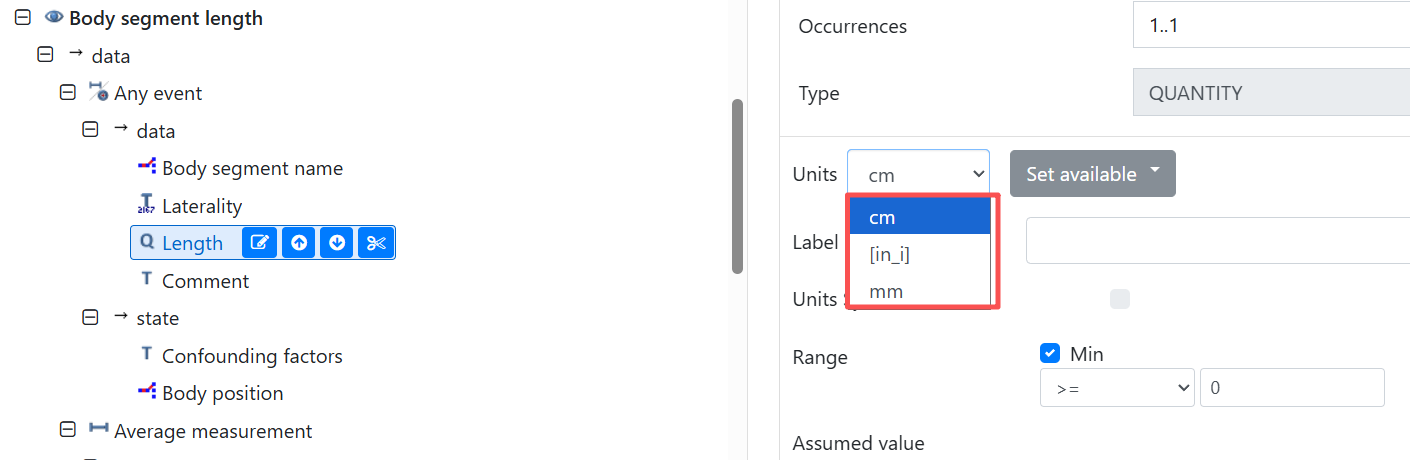
“Fingers” as a unit of length measurement is inherently problematic. Whose fingers, and which? And is it finger height, length, width or something else? In any case it’s not a UCUM unit and therefore difficult to fit in a DV_QUANTITY data type.
But the way I read LEMON, it looks like it’s not really about measuring distances in numbers of fingers. Rather, it looks like it’s about answering three yes/no questions about whether:
the patient can fit three fingers (I’m assuming side-by-side and vertically?) between their teeth
the distance from the bottom of the chin to the hyoid bone is at least 3 fingers (widths?)
the distance between the hyoid bone and the thyroid cartilage is at least 2 fingers (also widths?)
This could be represented using an archetype made for this purpose alone, or alternatively using one of the screening questionnaire archetypes?
Patient’s fingers. This has some merit, accommodating both adults and children, but it is indeed inaccurate.
But the way I read LEMON, it looks like it’s not really about measuring distances in numbers of fingers. Rather, it looks like it’s about answering three yes/no questions about whether
I totally agree, but a hospital we serve has records on the number of fingers traditionally.
This could be represented using an archetype made for this purpose alone, or alternatively using one of the screening questionnaire archetypes?
Perhaps you are right, I’m gradually thinking that what I need is a questionnaire archetype about LEMON.
If LEMON is a well known and commonly used assessment, it can be be represented in an OBSERVATION. Something like this: Archetype Designer , which is a rough draft only. It must be further investigated. For example on the use of a internal Cluster to represent the 3-3-2 rule, or have them as elements on root level. And of course the meta information, including any licencing and copyright information.