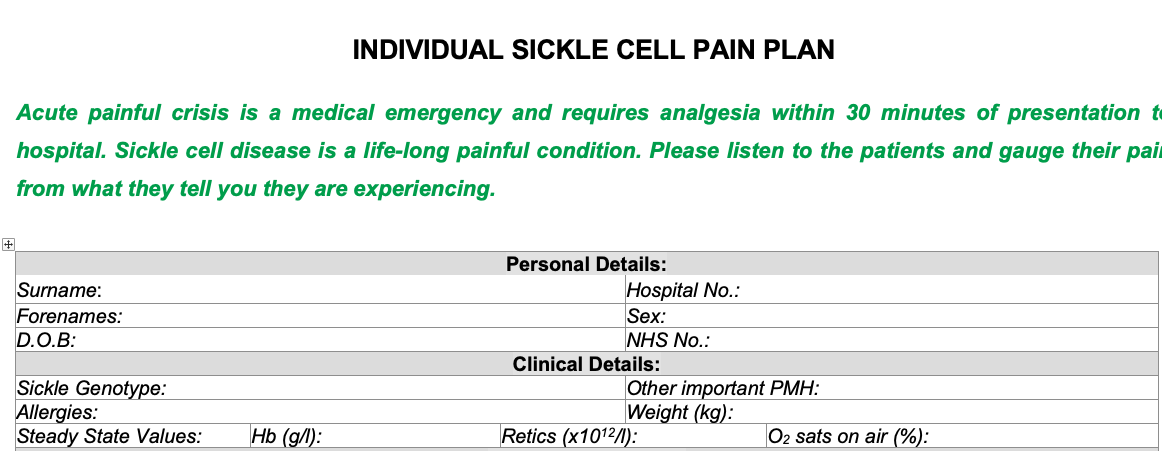
We had a use-case in the London UCP for ‘steady-state’ or ‘usual’ SPO2 levels in the context of a sickle cell disease support plan i.e “what does the person’s SPO2 normally run at”. This is helpful in emergency settings for understanding the deviation from that person’s individual norm.
We created a new archetype for this but on reflection I wonder if we could have used Goal or even an OBSERVATION with an extension to the interval types like mean.
However, for me, neither Goal nor an Interval Observation really fits the intent here.
Yes definitely .. (or probably!) . So for a paramedic attending a patient who hassome kind of chronic respiratory/haematological condition, knowing what their personal ‘day-today’ SPo2 looks like when not unusually unwell. Somewhere between an average/ estimate/baseline. But certainly not an actual value, actual average or actual target.
IMHO, as with other conditions (such as COPD with chronic respiratory failure), these measures reflect a person’s baseline status in relation to a particular condition. Their usefulness in patients with altered or pathological baseline values is twofold. On the one hand, they help distinguish a genuine worsening or exacerbation from a state of ‘normal’ that is different for someone living with altered baseline values. On the other hand, they help to adjust the intensity of treatment to restore the patient to those altered baseline values, rather than to normal values, in order to avoid unnecessary toxicity. In the first case, I might model this as ‘Specific details’ of
openEHR-EHR-EVALUATION.problem_diagnosis.v1 or, in the case of a form, as ‘Additional Details’ in
openEHR-EHR-OBSERVATION.problem_screening.v1. In the second case, perhaps as ‘Directions’ in
openEHR-EHR-INSTRUCTION.therapeutic_item_order.v1.
This type of information can be seen as a sort of “confounding factors” which is part of the State in many OBSERVATION archetypes. For Body Weight, it can used to document if the patient is missing one leg, hence the deviation from ‘expected’ weight based on age and heigth. Does it make sense to make a general “Deviation from normal range” CLUSTER to be inserted wherever it suits?