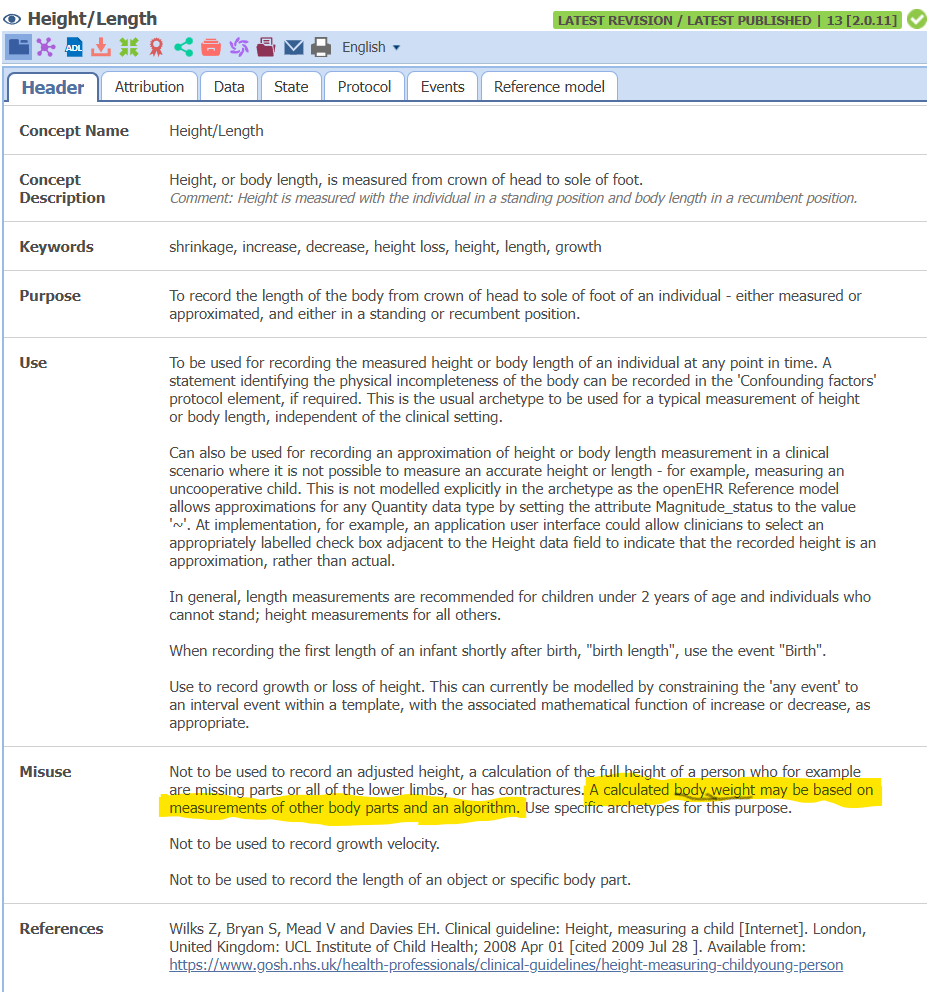
Hi, We are translating archetypes related to vital signs to Swedish and have encountered some difficulties that we would like help in setting straight. More specifically it regards the misuse section of the archetype Height/Length (openEHR-EHR-OBSERVATION.height.v2).
In the misuse section, it is stated “A calculated body weight may be based on measurements of other body parts and an algorithm.”
Since we don’t know the algorithm that this archetype refers to, we cannot understand how a “a calculated body weight…and an algorithm” helps in calculating a height/length. Could this phrasing be due to a linguistic error? or can someone please explain the algorithm so we know how to translate it.
I think this is trying to say that you should use a different archetype for calculated heights since they will require details of a specific algorithm. So this archetype does not carry an algorithm by design.
There are body measurements that use length to determine body weight, I think the misuse it trying to articulate that this archetype should not be used for that purpose.
I understand that this sentence in the misuse section is saying to not use this specific archetype for calculating an adjusted height, however, why is it refering to another archetype with an algorithm for calculating body weight?
I am inclined to agree with @sebastian.garde that wight should be changed to height.
If we are wrong in this assumption that the wording is due to a typo, is there an algorithm (not necessarily within any archetypes) that uses body weight to calculate a height?
So if I understand correctly, there are three possible interpretations of the current misuse statement in the Height/Length archetype:
It may simply be a typo, and the word “weight” should actually read “height” – which would make the intention clearer. This Is what we assumed, especially when we compare with the archetype body weight.
It may be pointing out that calculated height (derived from an algorithm rather than directly measured) should not be recorded with this archetype, since this archetype is only for direct measurements.
Or, as mentioned, it might actually be referring to the fact that some algorithms do indeed use length/height to estimate body weight – in which case the intention is to say that this archetype should not be used for those derived/indirect calculations either.
From a translation perspective, we just need to know which of these interpretations the editorial team intends, so we can render it correctly in Swedish. Otherwise, it risks being misleading for implementers.
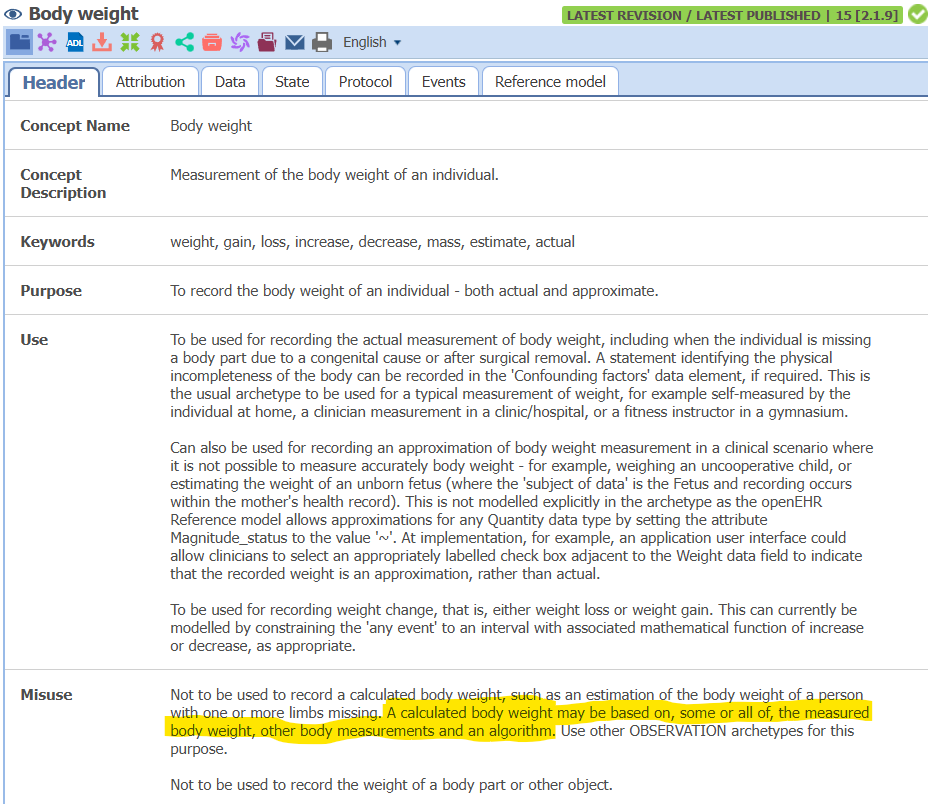
I think this is trying to mirror the Body weight archetype where the Misuse states: “Not to be used to record a calculated body weight, such as an estimation of the body weight of a person with one or more limbs missing. A calculated body weight may be based on, some or all of, the measured body weight, other body measurements and an algorithm. Use other OBSERVATION archetypes for this purpose.”
In the case of body height, body segments can also be used to calculate a height, using algorithms. See:
So we should correct and clarify the Misuse statement to: “Not to be used to record an adjusted height, such as an estimation of the full height of a person who is missing parts or all of the lower limbs, or cannot stand up straight due to contractures. An estimated body height may be calculated based on body segment measurements. Use a specific archetypes for this purpose.”
The problem is we don’t have adjusted or estimated weight or height archetypes. Yet. I’ve got some early drafts I’ve been working on today, but have run out of time to propose. Hopefully I can do that soon.
Thank you so much for the quick and thorough response Heather!
That makes perfect sense now, and it’s very helpful to see the connection with the Body weight archetype and the clarification around adjusted/estimated height. We’ll wait for the editorial team’s correction and any future archetypes you propose before finalising our Swedish translation.