Hello everyone,
I have noticed a lot of posts on Discourse recently that seem to be requesting some aid on work that we have been doing in the background at the Clinical Program Board (CPB) over the past few months. I was planning to make an announcement on social media (Discourse, LinkedIn, etc.) after EHRCON26, but I think it’s a good idea to share this here on Discourse for now.
By definition, a Working Group (WG) is a group of people who meet regularly to work on a shared topic and produce something useful for others like guidelines, proposals, documentation, or practical examples. It brings together different perspectives, discusses and solves problems as a team, and publishes the results so the wider community can use them.
On the Clinical Program Board (CPB), these groups can be formed by members of the CPB itself and externals that can give domain insight, but the proposal needs to start by a CPB member or CPB Expert Panel member - you can see the members on this page.
The main page of the working groups is at CPB Working Groups (CPB-WG)
All working groups are open to anyone who is interested in the topic and wants to contribute, whether you come from a clinical, technical, or other background. If you wish to participate in a working group, please send an email to comms@openehr.org or to the WG lead contact. Each working group has a confluence page with the description of the aim, leads and members whose page links are presented below.
If there is the wish of opening a working group, please check the page Initiation of CPB Working Groups where all the information regarding WGs are documented in detail.
Currently there are 6 established working groups (as 10/09/2026):
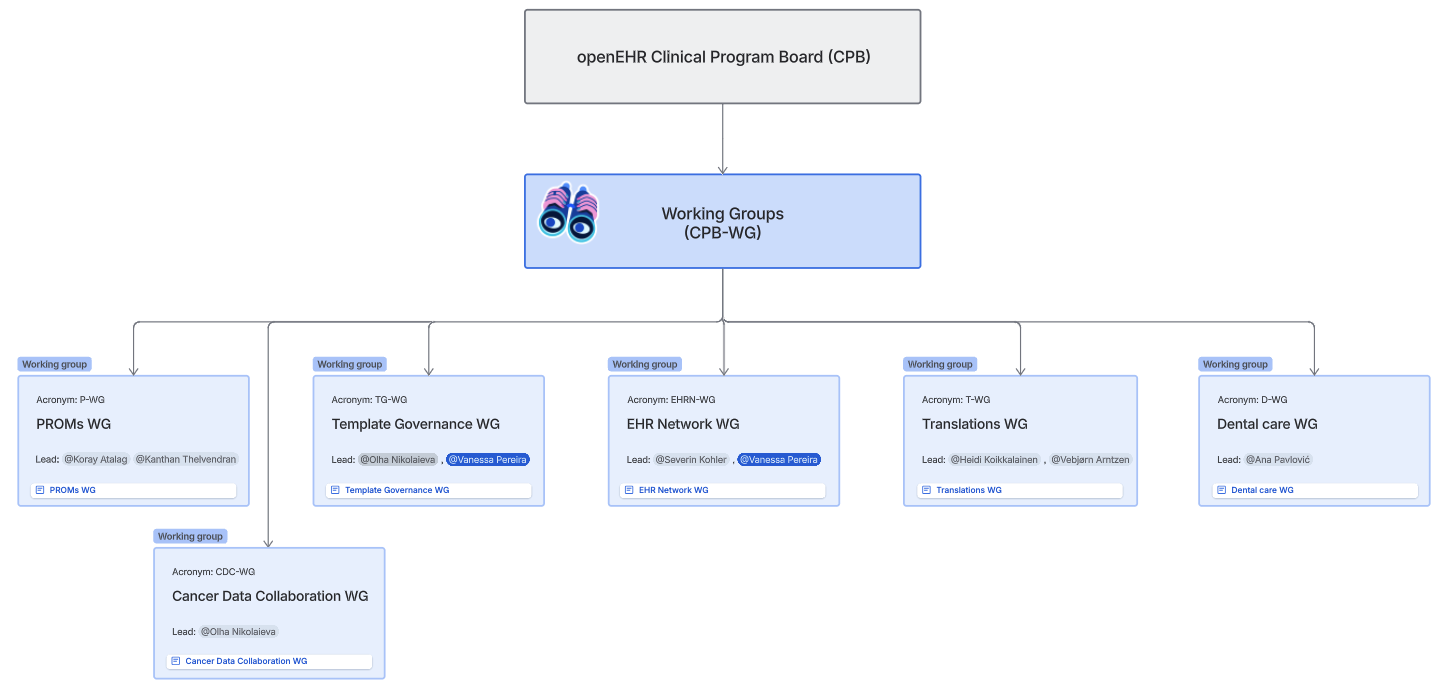
-
Patient reported outcomes and measurements (PROMS) - supports the creation of reusable, interoperable, and clinically validated openEHR models by providing guidance, technical expertise, and best practices for modeling PROMs. Establish direct collaboration with the organizations responsible for these clinical instruments to ensure their content remains accurate, validated, and up to date. Address licensing, copyright, and administrative challenges to help reduce the legal and technical barriers to implementation and reuse.
-
Cancer data collaboration - develop a structured understanding of the oncology domain, starting from the ECCDM and other relevant initiatives, and to identify how cancer-care information can be represented more comprehensively in openEHR.
-
Translations - Ensure clear and consistent translations of openEHR archetypes across languages. Provide guidelines and tutorials, and update or extend the current documentation if necessary. Support the management of translations in the CKM alongside CKAs, translation editors and translation administrators to minimise open branching.
-
EHR Network - make cross-border federated querying between European health institutions a regular practice by ensuring transparency, sharing knowledge, supporting newcomers, and growing a collaborative community
-
Dental Care - develop archetypes that represent important dental concepts in a clear, standardised and clinically meaningful way.
-
Template Governance - Define and formalize a consistent, community-agreed semantic versioning approach for openEHR templates aligned with ADL 2.4 HRIDs and existing archetype practices by specifying what constitutes major/minor/patch changes (e.g., archetype and terminology updates), documenting key use cases and roles, and providing practical guidance with recommendations for enforceable/automatable implementation in modelling tools.
We have also planned groups for the next months:
- Clinical modelling tooling - Improve the tools used for clinical modelling in openEHR by collecting real community issues, strengthening documentation and training, and working with tool builders to deliver practical fixes and upgrades along with current how-to.
- Demographics - Revitalizing current demographic archetypes and providing documentation on their usage and current state.
- Community enablement and documentation - This group will focus on building and organizing documentation (tutorials, guidelines, etc.) for the clinical modeling part of openEHR. This documentation will be published on a new webpage (similar to developer.openEHR.org). The group will also help on external engagement with the openEHR clinical and modelling community.
For more information or questions, feel free to reply here, contact comms, or send a direct message (DM).