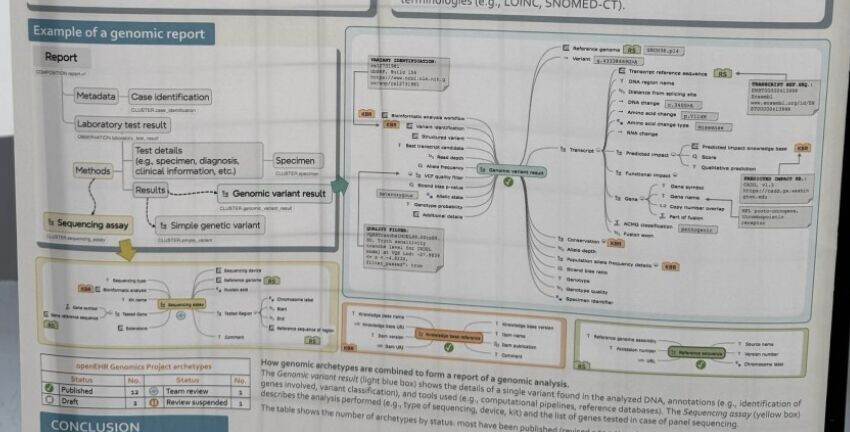
My use case is actually around Genomics but where I am at the moment is looking at is
-
metadata
-
Test Details
As shown in the diagram I was sent from EHRCON25
I’ve been able to navigate the results part and I’m confident I can explain to a developer how to convert to/from v2+FHIR+openEHR (or at least get them started).
Does openEHR have definitions for metadata and test detail? This is more of an administrative question and I suspect openEHR focuses on clinical.
Many thanks
What do you mean by metadata and test detail in this context?
I’d say we carry virtually all of the metadata and test detail required for a typical lab report.
This our take on a Genomic report to support testing for inherited cancer risk. This is the report, based on tumour ‘ somatic’ samples that goes to the Clinical scientist for review then forms part of the Molecular Tumour Board decision.
From what I can tell, this is pretty close to the template noted above from @ce.mascia and @surfer - are you able to share your template?
The only significant difference I can see is that we added a lab analyte cluster (OBX segment equiv) between the Lab Test observation and the genomics variant. We did this largely to keep aligned with ‘standard’ lab reporting practice but for now, at least the lab genomics feeds we are getting are not routed through V2 or FHIR.
Fromn your POV @Kevin_Mayfield1 is anything missing in terms of lab detail or ,etadata, bearing in mind that this is a low-level data feed?
The design is here North West Genomics Test Report - NHS North West Genomics v0.0.8
I can map everything with a genomic tag between HL7v2+FHIR+openEHR.
The admin and test details is where I have problems, at present this is IHE+HL7v2+FHIR.
For example take Case Number LOINC 56797-4, this is in the openEHR diagram and IHE+HL7v2+FHIR.
The design is here North West Genomics Test Report - NHS North West Genomics v0.0.8
I can map everything with a genomic tag between HL7v2+FHIR+openEHR.
The admin and test details is where I have problems, at present this is IHE+HL7v2+FHIR.
For example take Case Number LOINC 56797-4, this is in the openEHR diagram and IHE+HL7v2+FHIR.
We at crs4 had a similar problem with the BBMRI crc cohort data. You can find here the template:
as you can see we made use of the openEHR-EHR-CLUSTER.organisation.v1 and openEHR-EHR-CLUSTER.case_identification.v0 archetypes to store information such as the case number you cited. I don’t know if this is the orthodox approach, @ian.mcnicoll , who has a ton of experience, surely knows.
For what concern the genomic information all the archetypes the openEHR Genomic Group created can be found in the international CKM at
Thanks, yes as @surfer has suggested we would use the Organisation cluster archetype if an Organisation name/ID was required and have it in the Receiver slot (assuming name of the lab) . Probably nowadays we would use either the Encounter resource in a FHIR store or a linked service_encounter archetype (basically a clone of the FHIR resource, if people want to store the data in openEHR and put a FHIR wrapper around it.
The example I showed is a bit simpler since there is a very tight integration between the lab., and we don’t actually get a ‘case number’ as such from the lab but I’ll discuss with colleagues.
I’m seeing this modelling issue in a number of places but it is a lot clearer and more distinct here. It is roughly
This also appears to split up standards with IHE + HL7 v2 looking at the former two, and openEHR and FHIR profiles the later.
FHIR RESTful (read only) does tend to also be in the former, and this uses a more generic version of FHIR profiles.
FHIR is confusing this, as it’s sitting in both groups. I think the distinction is
Based on that split I have
Well demographic data is typically managed outside openEHR, though I liked a lot the work done by @sebastian.iancu, presented at EHRCON25 for integrating demographics into the core model (btw the aql queries on demographics+ehr look very powerful and promising).
For the test detail metadata, as @ian.mcnicoll suggested, you can check the laboratory test result.
@ian.mcnicoll I’m curious about the service_encounter archetype. is it an “integration archetype” ( Architecture Overview ) ? Is it something done locally, stored only at the local CKM, or is it part of a global strategy for openEHR to map many FHIR resources/profiles and release them globally (international CKM) ? is there a governance for the creation and management of those archetypes?
Not sure what you mean by ‘References’ in this context.
I’d disagree that EHR standards sit in a single domain The big challenge is that most sit in multiple overlapping domains . It is definitely not ‘a big ball of mud’ but neither is is possible to separate cleanly into multiple non-overlapping domains. I love the domain-driven design idea but not sure it cleanly translates into the morass of clinical systems, especially at patient-level
Is that available in a more generic form? I’m trying to not be domain specific (I’m also having issues with another orgs FHIR profiles here  on a practical level I can’t use it)
I don’t think they do either, I think Data MESH is an appropriate here but I think this reinforces the real difference between IHE (and HL7) + DDD and openEHR (and many FHIR profiles) + Data MESH?
For example: Domain Archetype from Data MESH appears to work quite well with openEHR (and FHIR profiles).
In Domain Driven Design I would link to those archetypes via an identifier - I often don’t have archetypes themselves.
p.s. I do love this split. It means I’m decoupled from clinical archetypes in either FHIR profile or openEHR format, as I’m mostly in DDD environments.